When & where did it fail? — Landing (contact slip / hard impact) versus Braking (locked wheel). Diagnosis from the «signature» each mechanism leaves, with authentic reference photographs and the decisive tests.
Landing vs BrakingSpin-up · Hard impact · Locked wheel · Reverted rubberMaj(P) Koroniadis Nikolaos — 364SQN/120FTW
At the moment of touchdown the wheel is stationary and, within a fraction of a second, must reach ground speed. While it accelerates it slips — but at the same time it begins to spin up, so the friction is spread over a large arc and never has time to «dig in».
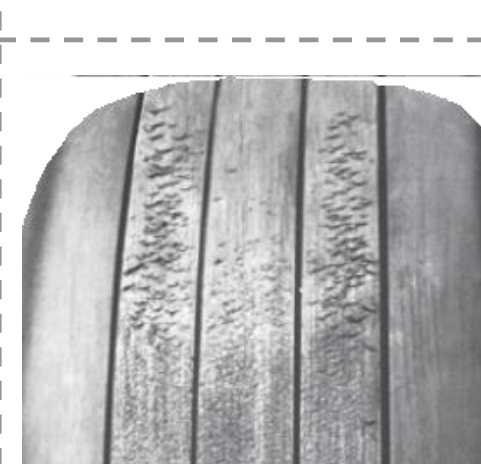
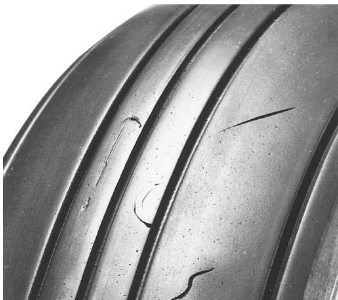
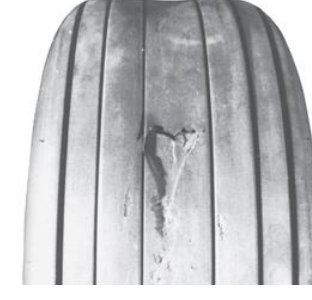
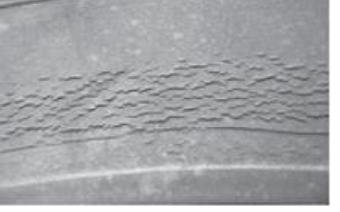
Photo of 'What' · Goodyear ATCMM (6/2024), p. 31 — «Chevron Cutting»
Sketch of 'why' · shallow · spread arc · V-cuts
How to tell it apartBroad, shallow, symmetric scrub; often V-shaped cuts (chevron). Rarely reaches the cords — never a deep «crater».
Typical exampleIn the touchdown zone of every runway — the black rubber marks from spin-up. Pronounced chevron cutting appears on cross-grooved runways. [Goodyear ATCMM]
BLanding · high sink rate
Hard impact
Here the issue is not slip but the vertical load. The tire is compressed at the contact patch and the sidewalls are over-stretched — so the damage shifts from the tread to the structure.
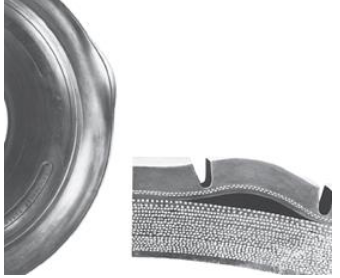
Photo of 'What' · Goodyear ATCMM (6/2024), p. 30 — «Thrown Tread» (structural failure)
Sketch of 'why' · vertical load · sidewall bulge
How to tell it apartDamage on the sidewall/bead, a bulge, or ply separation — with the tread often intact. Strong indicator: accompanying damage to the wheel or landing gear.
Typical exampleA hard/heavy landing above the certified sink-rate limit → a mandatory «hard landing» inspection (AMM): the beads and structure are checked, while the tread may look clean. [Goodyear ATCMM, p. 23/27]
CBraking · locked wheel
Locked wheel
Without anti-skid, when braking torque exceeds the available friction the wheel stops turning while the aircraft keeps moving. A single point of the tread drags continuously in the same place and is quickly abraded down to the cords.
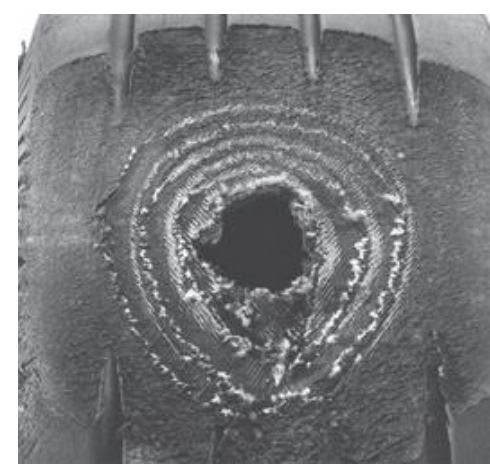
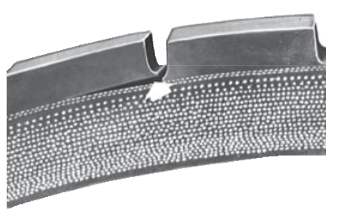
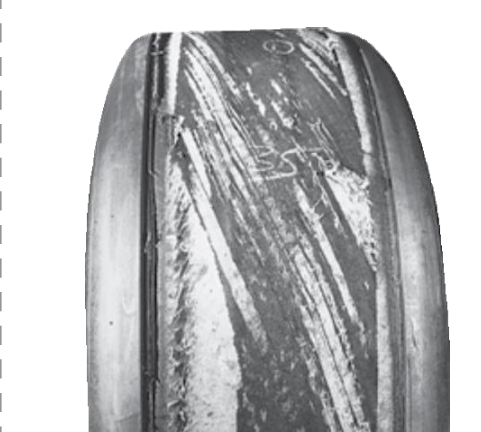
Photo of 'What' · Goodyear ATCMM (6/2024), p. 31 — «Skid»
Sketch of 'why' · stationary wheel · 1 deep flat spot → cords
How to tell it apart from spin-upA deep, localized flat spot in the center, with abraded cords (dry abrasion). Key: depth to the cords + localization.
Typical exampleAn aircraft without anti-skid (or with the system inactive / emergency brake applied directly) braking hard on a dry runway — a single deep flat spot abraded to the cords (the «Skid» category). [Goodyear · SKYbrary]
DBraking · wet — reverted rubber
«Reverted» rubber
On a wet runway, the locked wheel generates so much heat that it melts the rubber at the contact patch and traps steam. The steam lifts the tire — reverted rubber (steam) aquaplaning.
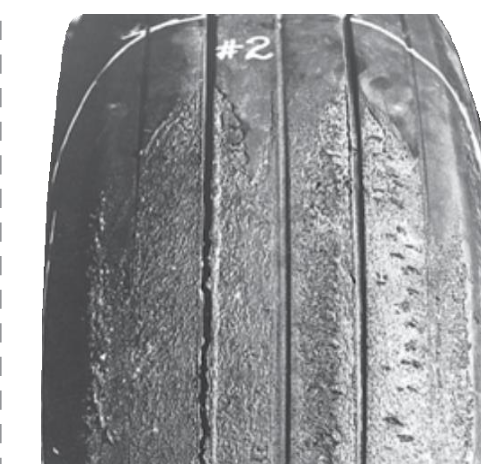
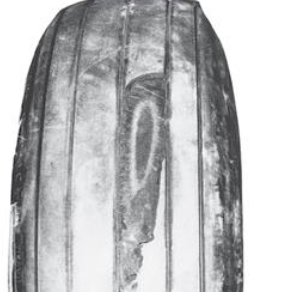
Photo of 'What' · Goodyear ATCMM (6/2024), p. 31 — «Tread Rubber Reversion»
Sketch of 'why' · steam · glassy oval · wet
The critical testGlassy, blistered, «boiled» rubber (not abraded cords) + white steam marks. Abraded → Dry; melted/glassy → Wet.
Documented exampleEMB 145, Nuremberg, 18 Jul 2005 (BFU EX005-0/05). Landing on wet runway 28; the mean deceleration from braking was minimal — comparable to that of a very slippery runway — and light-colored, glossy braking marks were found together with a large amount of detached rubber on the runway. [BFU]
03
The decisive tests at a glance
Criterion
Contact slip (spin-up)
Hard impact
Lock-up (braking)
Location
tread, spread
sidewall/bead/wheel
tread, localized
Depth
shallow, no cords
internal / structural
down to the cords
Shape
arc / V-cuts (chevron)
deformation / bulge
one deep flat spot
Accompanying sign
V-cuts on the tread
wheel / landing-gear damage
abraded cords
Position on runway
touchdown zone
point of contact
far end of the runway
When they coexist (combined mechanisms)
If they happen together you will see several signatures at once: scrub/chevron on the tread, sidewall/bead damage AND a flat spot.
The diagnostic key is that all the signatures look «fresh» (of the same age) and are co-located; the report then assigns each mechanism a contributing factor — not an exclusive cause.
To reconstruct the time sequence — which mechanism came first — we use the position of the marks along the runway: landing damage is laid down early, in the touchdown zone, while braking damage appears later, toward the far end. The picture is confirmed by the flight recordings — vertical acceleration (vertical g) at touchdown, wheel speed and brake pressure — so we can separate what occurred first from what followed.
05
Case study — landing on a wet runway
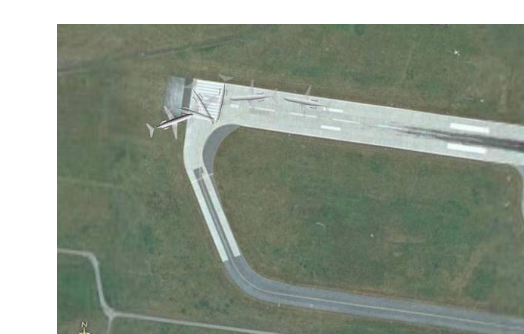
Aircraft position after the ground loop — Photo: BFU
Locked wheels & reverted rubber, without anti-skid
Approach through a thunderstorm; landing on wet runway 28 with an increased approach speed. Braking did not stop the aircraft before the end of the runway; a runway excursion and a ~200° ground loop followed, with the main gear in the grass.
On the runway, light-colored, glossy braking marks with a glassy, «polished» appearance were found, along with a large amount of peeled rubber — the classic signature of reverted rubber aquaplaning.
Braking: minimal effectVAPP 148 ktRWY 28 · wet
06
Other common tire failures — recognition catalogue
Beyond the four landing/braking mechanisms, technical personnel encounter other failure categories too. They are not necessarily related to the scenario examined here — they are listed as a visual recognition guide (Goodyear ATCMM reference photos, pp. 29–33).
Cuts
Penetration of the tread by a foreign object (FOD) on a runway or apron.
Remove if the cords are exposed
Tread Chunking
Loss of pieces from the tread surface, usually on rough or unpaved runways.
Remove if the cords are visible
Tread Separation
Detachment of the tread from the carcass — loss of bond between plies due to overload or overheating from under-inflation.
Remove immediately
Rib Undercutting
A groove crack extending beneath a rib; can lead to chunking, a peeled rib, or thrown tread.
Remove immediately
Peeled Rib
Starts from a tread cut and develops into circumferential detachment of a rib down to the reinforcing fabric.
Remove immediately
Weather / Ozone Checking
Shallow, random sidewall cracks from aging — prolonged exposure to ozone, sunlight, and poor storage conditions.
Remove if the cords are visible
This is a tool for classifying the most likely cause — not proof. A visual inspection does not replace a teardown of the tire.
The «localized vs spread» boundary is a gray area when a momentary lock-up transitions into a brief slip. The photographs are for reference and are not from any specific occurrence.
SKYbrary, «Aquaplaning» — the reverted rubber mechanism (locked wheel on a wet surface, steam, «boiling» of the rubber). skybrary.aero/articles/aquaplaning
BFU (Germany), report EX005-0/05 — E145, Nuremberg 2005: locked wheels & reverted rubber without anti-skid (case study & aerial photo).